Tel:+86 133 6177 9811
Fax:+86 0797 5712751
Email:sale02@miningshakingtable.com
Address:Guzhang Industrial Park,Shicheng County,Ganzhou City,Jiangxi Province,342700,China.
A side-acting diaphragm jig is a gravity separation device Its core feature is that the diaphragm is vertically installed on the side wall below the sieve plate of the jig chamber
A side-acting diaphragm jig is a gravity separation device. Its core feature is that the diaphragm is vertically installed on the side wall below the sieve plate of the jig chamber.
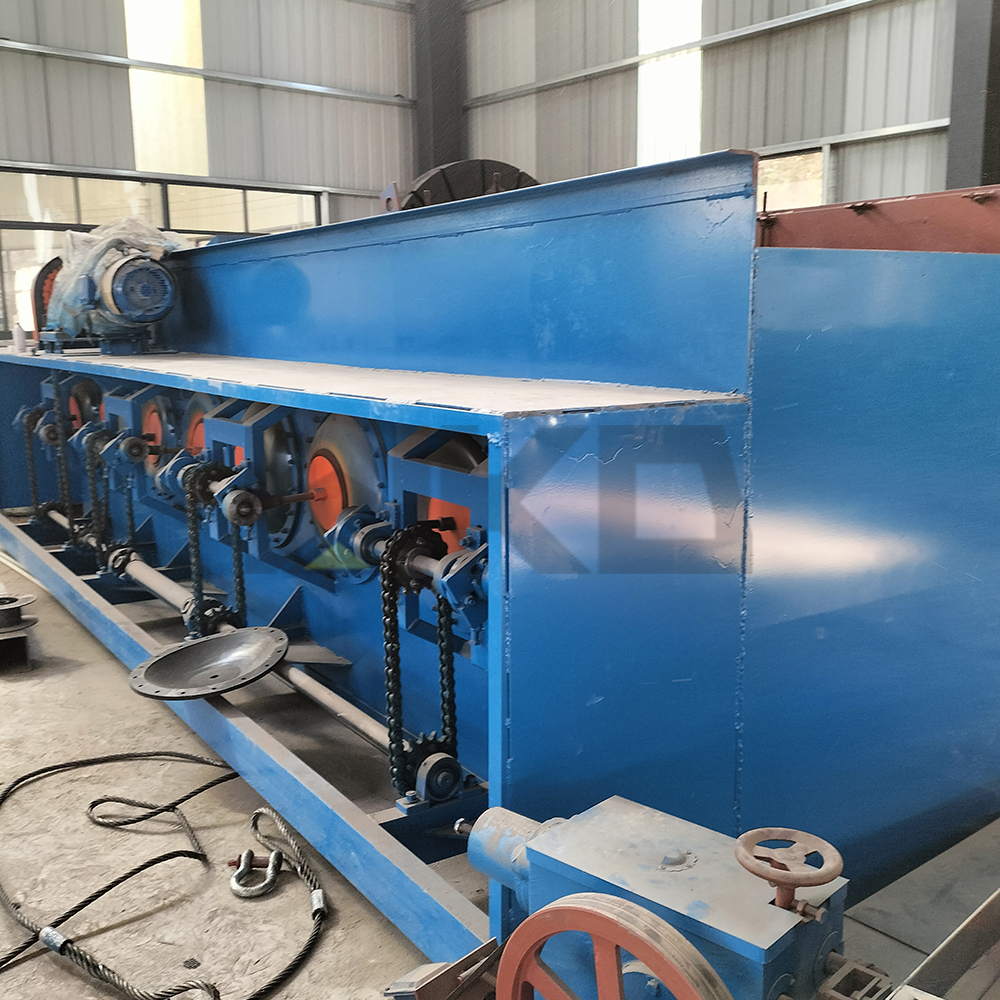
Working Principle
The equipment uses an eccentric linkage mechanism to drive the diaphragm to reciprocate horizontally, thereby generating a vertical pulsating water flow within the jig chamber. Under the action of the pulsating water flow, the feed material will stratify according to density: denser, heavier mineral particles settle to the lower layer, while less dense, lighter mineral particles float to the upper layer. Finally, products of different densities are discharged separately through different discharge devices, achieving mineral separation.
Main Structural Classification
Based on the shape and structure of the jig chamber, side-acting diaphragm jigs are mainly divided into two categories:
1. Trapezoidal Side-Actuating Diaphragm Jig
Structural Features: The width of the jig chamber gradually increases from the feed end to the discharge end, forming a trapezoidal shape. For example, the 2LTC-6109/8T jig has 8 jig chambers arranged in two rows.
Advantages: This structure allows the bed thickness to gradually decrease from front to back. Combined with adjustments to the stroke and frequency, it can efficiently separate coarse and fine-grained minerals simultaneously, offering strong adaptability.
Applications: Widely used for processing ores such as iron, manganese, tungsten, and tin, especially suitable for applications with large throughput and a wide range of feed particle sizes.
2. Rectangular Side-Mounted Diaphragm Jig
Structural Features: The horizontal cross-section of the jigging chamber is rectangular. Common structures include single-row two-chamber and double-row four-chamber designs, such as the AM-30 and LTC-75 models.
Advantages: It has a wide adjustable stroke range (up to 50-100mm), enabling it to process coarse-grained ores with a higher upper limit for particle size.
Applications: Suitable for separating coarser-sized iron, manganese, tungsten, tin, and gold-bearing ores.
Core Advantages and Application Areas
Wide Applications: A powerful tool for fine particle separation in mineral processing, widely used in the beneficiation of metallic ores such as tungsten, tin, gold, iron, and manganese, as well as some non-metallic minerals. It can also be used to recover useful substances from smelting slag.
High Separation Efficiency: Excellent separation effect on fine and micro-fine particles (e.g., 0.074-5mm), with high recovery rate.
Energy Saving: Optimized transmission design results in low energy consumption, saving more electricity than some traditional equipment.
Reliable Structure: Simple and compact structure, easy maintenance, and low failure rate.