Tel:+86 133 6177 9811
Fax:+86 0797 5712751
Email:sale02@miningshakingtable.com
Address:Guzhang Industrial Park,Shicheng County,Ganzhou City,Jiangxi Province,342700,China.
When the well-prepared slurry is fed from the top at a certain concentration and flow rate, it flows downward along the inclined surface of the chute. During this process, mineral particles are subjected to the combined effects of gravity, centrifugal force, friction, and hydrodynamic forces.
Dense minerals such as tantalite-columbite, zircon, cassiterite, etc., tend to move towards the inner edge of the chute and are discharged from the concentrate outlet; while lower-density gangue minerals like silica sand are carried by the water flow to the outer edge and discharged as tailings.
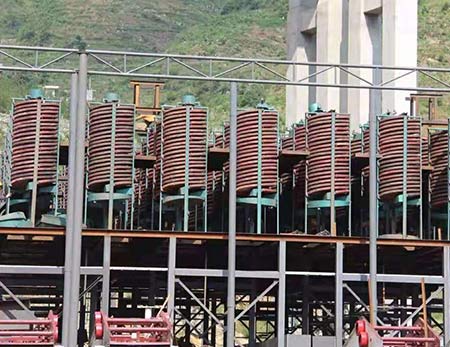
Large Processing Capacity: The raw ore throughput of coastal sand deposits is often enormous. A single spiral chute unit has a large processing capacity and can be operated in parallel with multiple units, enabling efficient handling of large volumes of material. It is very suitable as the first stage of roughing to quickly discard most of the tailings and concentrate valuable minerals.
Energy Saving: The spiral chute operates entirely by gravity. The entire separation process requires no additional power, significantly reducing energy consumption and operating costs, which is very important for mineral processing plants.
Suitable for Medium to Fine Particles: After preliminary screening by a trommel screen, coastal sand raw ore has a relatively uniform and relatively fine particle size. The spiral chute performs very well in separating these medium to fine-sized materials.
Simple Structure and Easy Maintenance: The spiral chute mainly consists of the chute body and support structure, with no complex moving parts, resulting in low failure rates and simple operation and maintenance. Its chute body is made of FRP (Fiber Reinforced Plastic) or high-strength ABS plastic, offering strong adaptability to coastal environments, being wear-resistant and corrosion-resistant.
Roughing: The slurry undergoes primary separation via the first pass through spiral chutes, yielding a rough concentrate with high heavy mineral content and tailings primarily consisting of silica sand.
Scavenging and Cleaning: The tailings typically require further scavenging to improve the overall recovery rate. The rough concentrate then enters smaller diameter spiral chutes or shaking tables for cleaning, further increasing the concentrate grade.
Final Separation: The mixed concentrate enriched by the shaking table needs further separation using equipment like three-disc magnetic separators and high-tension electrostatic separators to obtain final individual products such as ilmenite, zircon, monazite, etc.