Tel:+86 133 6177 9811
Fax:+86 0797 5712751
Email:sale02@miningshakingtable.com
Address:Guzhang Industrial Park,Shicheng County,Ganzhou City,Jiangxi Province,342700,China.
Spiral chutes primarily utilize the inertial centrifugal force generated by the rotation of a spiral to separate light and heavy minerals. Due to their simple structure and large processing capacity, they are widely used in gravity separation processes. Currently, mineral resources face challenges such as depletion, refinement, and hybridization. Improving the beneficiation efficiency and recovery rate of separation equipment has become a top priority in current mining development and research. This article mainly teaches you how to effectively improve the beneficiation efficiency of spiral chutes from three aspects.
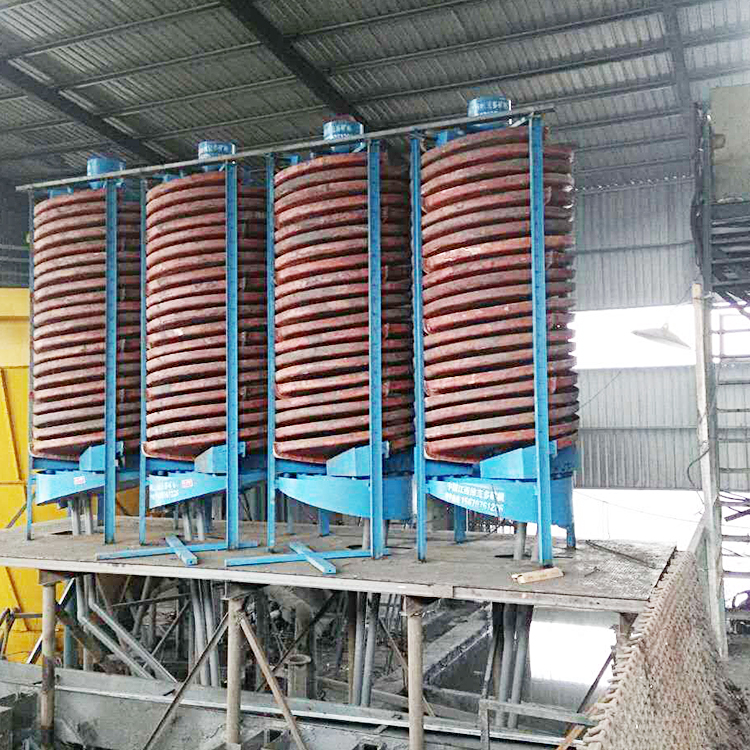
I. Structural Parameters and Performance of the Spiral chute itself
1. Spiral Chute Diameter
The diameter of the spiral chute directly affects the processing capacity and the recovery rate of minerals of different particle sizes. Generally speaking, the larger the diameter of the spiral chute, the larger the mineral flow volume and velocity, and the greater the processing capacity per unit time. Based on practical experience, the smaller the diameter of the spiral chute, the smaller the lower limit of the recovered particle size, and the higher the recovery rate.
2. Longitudinal Inclination Angle of the Spiral Chute: The angle between the tangent to the cross-sectional curve of the spiral chute and the vertical axis is called the longitudinal inclination angle. The larger the longitudinal inclination angle, the faster the slurry flow velocity, and the greater the centrifugal force on the material. Therefore, a small inclination angle is used when separating fine-grained minerals, and a large inclination angle is used when separating coarse-grained minerals. A suitable longitudinal inclination angle allows the slurry to flow smoothly along the sluice body, achieving good mineral processing indicators and improving processing efficiency.
3. Transverse Inclination Angle of the Spiral Chute: The transverse inclination angle is complementary to the longitudinal inclination angle. The transverse inclination angle also affects the distribution of the slurry flow on the sluice surface. The larger the transverse inclination angle, the greater the water flow depth. Therefore, a small transverse inclination angle is used when separating fine-grained ores, and a large transverse inclination angle is used when separating coarse-grained ores.
4. Number of Spiral Chute Turns: The number of spiral sluice turns determines the separation distance and the length of the separation time. In practical operation, the number of spiral chute turns needs to be determined based on the properties of the feed material and the required operating parameters. When valuable minerals and gangue minerals are closely intercalated and difficult to separate, a larger number of turns is preferable to extend the separation distance and time, thereby improving separation efficiency. However, the number of turns should not be excessive, otherwise it will increase the height of the spiral chute and increase the difficulty of operation. Industrial separation typically uses 4-6 turns of spiral chute.
5. Inner Surface of Spiral Chute
The inner surface of the chute must be flat, uniform, and wear-resistant to ensure smooth slurry flow and prevent clogging. To enhance wear resistance, polyurethane wear-resistant rubber is usually coated on the inner surface of the fiberglass spiral chute.
II. Characteristics of Feed Ore
Appropriate feed particle size, shape, and density are of great significance for the separation of valuable minerals and gangue minerals.
1. Mineral Particle Size
Generally, the upper limit of the feed particle size for spiral chute is 6mm. Clay minerals require desliming and classification before feeding to prevent material blockage and maintain separation efficiency.
2. Mineral Particle Shape
The shape of mineral particles also affects the movement speed of minerals in the spiral chute. When the useful heavy minerals are mostly irregular or platy in shape, and the gangue minerals are round, the movement speed of the heavy minerals is slow, which is conducive to stratification and settling, reducing the tailings grade and improving the separation efficiency.
3. Mineral Density
Since the spiral chute mainly relies on the density difference of minerals for separation, the greater the density difference between the useful minerals and gangue minerals in the feed ore, the more favorable the separation.
III. Process Parameters in Spiral Chute Operation
1. Feed Volume
The feed volume affects the thickness and velocity of the ore flow to a certain extent. Therefore, to improve efficiency, the feed volume for coarse-grained materials should be large, and the feed volume for fine-grained materials should be small.
2. Feed Concentration
The spiral chute requires a feed concentration greater than 30%, which should not be too high or too low. If the feed concentration is too high, the viscosity of the slurry increases, the ore layer is not easy to loosen, resulting in obstructed mineral particle settling, seriously affecting the stratification effect and the movement speed of mineral particles, thereby reducing the concentrate grade and recovery rate. If the feed concentration is too low, the throughput per unit time will decrease, the mineral layer will become thinner, and it will be impossible to separate and zone the minerals. This will lead to an increase in the slurry flow rate, and useful heavy minerals will be discharged before they can separate and settle, thereby increasing the tailings grade and reducing the separation efficiency.