Tel:+86 133 6177 9811
Fax:+86 0797 5712751
Email:sale02@miningshakingtable.com
Address:Guzhang Industrial Park,Shicheng County,Ganzhou City,Jiangxi Province,342700,China.
In mineral processing plants, the grinding stage is a crucial step involving significant investment and energy consumption. The grinding process controls the particle size variation throughout the entire mineral processing flow, significantly impacting the plant's productivity and recovery rate. Therefore, how to reduce costs and improve productivity while maintaining a certain grinding fineness standard using ball mills is a matter of considerable concern.
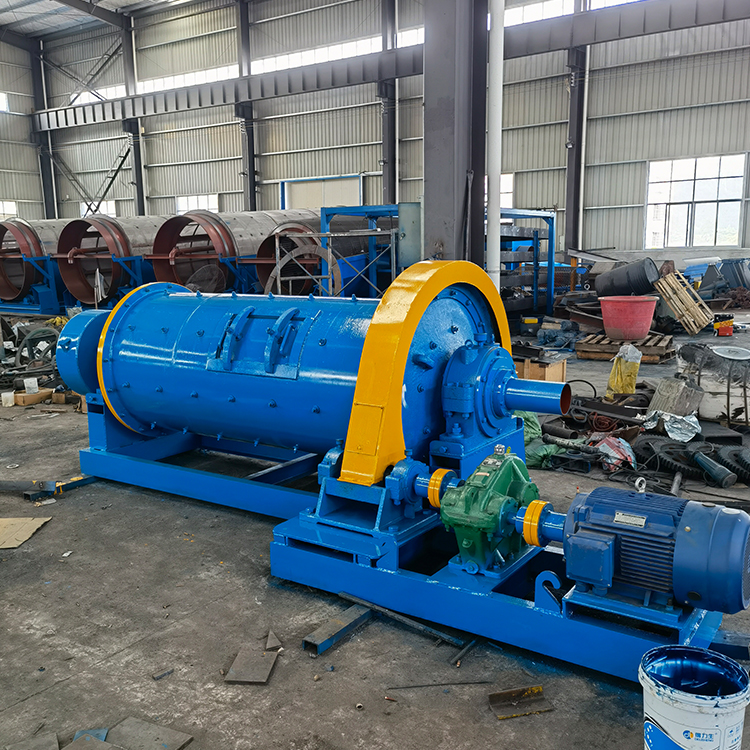
There are two grinding methods: open-circuit grinding and closed-circuit grinding. What are the characteristics of these two grinding methods? Which grinding method can achieve efficient utilization of grinding equipment and improve productivity?
Open-circuit grinding and closed-circuit grinding methods and characteristics
Open-circuit grinding: This refers to a grinding operation where the material fed into the ball mill, after one grinding pass, directly enters the next mill or the next process step.
Advantages of open-circuit grinding: The production process is relatively simple, and the initial investment cost is lower. Its disadvantages are lower production efficiency and higher energy consumption during production.
Closed-circuit grinding: This refers to a grinding process where the material fed into the mill undergoes one grinding pass, followed by classification. Ore that does not meet the particle size requirements is returned to the mill for regrinding, while ore that meets the particle size requirements is sent to the next stage.
Advantages of closed-circuit grinding: It achieves a high crushing rate and produces high-quality products. The output of closed-circuit production is also relatively large within the same timeframe. However, its main disadvantages are a more complex process flow and higher initial investment costs.
Before reaching the acceptable particle size, unqualified materials are repeatedly ground in the closed-circuit grinding stage. A larger amount of mineral can be fed into the grinding equipment during grinding, maximizing the utilization of the ball mill's energy and improving the efficiency of the grinding equipment, thus increasing production efficiency.
Equipment Use in Open-Circuit and Closed-Circuit Grinding
In terms of grinding equipment selection, ball mills, because they lack the ability to control particle size, produce both acceptable fine particles and unacceptable coarse particles in the discharge, making them unsuitable for open-circuit grinding. In contrast, rod mills preferentially crush coarse particles between the steel bars. The upward-moving bars act like a series of grating screens, allowing finer particles to pass through the gaps. Therefore, rod mills have the ability to control particle size and can be used as grinding equipment in open-circuit grinding.
While ball mills themselves lack particle size control, they can utilize classifying equipment. The ore discharged from the mill enters the classifying equipment; qualified fine particles are recycled to the next stage, while unqualified coarse particles are returned to the grinding equipment for further grinding. Therefore, in closed-circuit grinding, unqualified coarse particles may pass through the mill several times and must be ground to a suitable particle size before being discharged by the classifying equipment. There are virtually no restrictions on the grinding equipment that can be chosen for the closed-circuit grinding stage.
Applications of Open-Circuit and Closed-Circuit Grinding in Beneficiation Plants
Depending on the type and properties of the ore, and the requirements of the beneficiation process, the required grinding fineness varies. Different compositions of materials require different degrees of liberation; therefore, the appropriate grinding method should be determined based on experimental analysis of the mineral properties.
In closed-circuit grinding, most of the material returned to the grinding mill is close to the acceptable particle size, requiring only slight regrinding to become a qualified product. Furthermore, the increased material volume within the mill allows for faster material flow and shorter grinding time. Therefore, closed-circuit grinding is characterized by high productivity, minimal over-grinding, and a finer product with a uniform particle size distribution. Generally, flotation plants and magnetic separators mostly employ closed-circuit grinding processes.
Open-circuit grinding is typically used as the first stage in a two-stage grinding process. The material discharged from the first-stage rod mill enters other grinding equipment for further (fine) grinding. This allows the first-stage rod mill to have a smaller crushing ratio and higher production capacity, with a simpler process flow.
In summary, the selection of a grinding method is quite complex, requiring comprehensive consideration of material properties, investment costs, process flow, and many other factors.