Tel:+86 133 6177 9811
Fax:+86 0797 5712751
Email:sale02@miningshakingtable.com
Address:Guzhang Industrial Park,Shicheng County,Ganzhou City,Jiangxi Province,342700,China.
Magnetic separation technology mainly relies on the differences in magnetic properties among minerals in the ore. It achieves mineral separation under the action of magnetic force and other mechanical forces, and is now widely used in the separation of ferrous metal ores, the beneficiation of non-ferrous and rare metal ores, and the separation of some non-metallic ores.
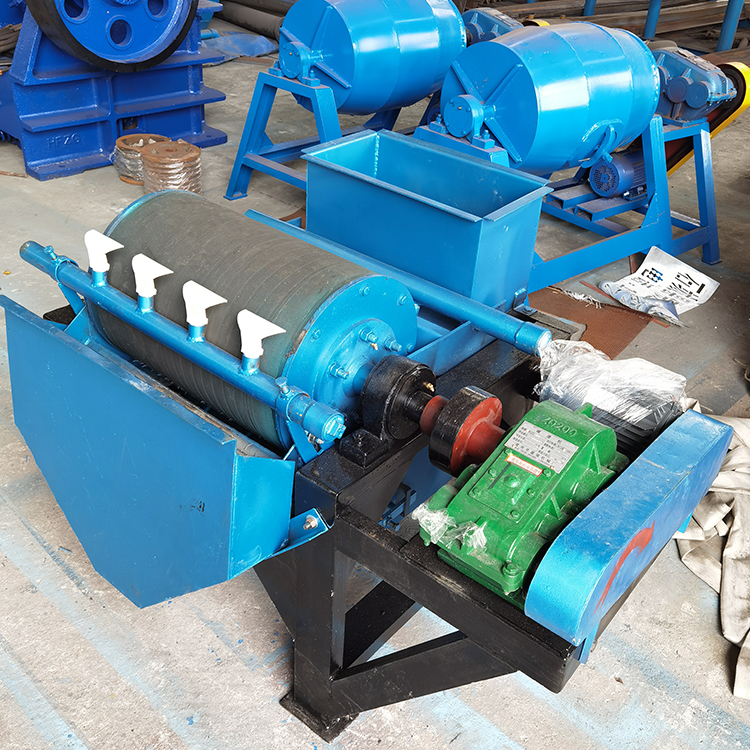
Simply put, the working principle of a magnetic separator is that when the slurry enters the separation zone, magnetic mineral particles are magnetized under the action of a non-uniform magnetic field. They are attracted by the magnetic field and adhere to the separator cylinder, then carried by the rotating drum to the discharge end, becoming the magnetic product. Non-magnetic mineral particles, subjected to less magnetic force, remain in the slurry and are discharged as the non-magnetic product.
To achieve ideal magnetic separation results, we must first understand which factors affect the separation effect of the magnetic separator. This allows us to pay closer attention during operation and obtain good separation indicators.
Factor 1: The size of the feed particle size
The feed particle size is a crucial factor affecting the separation effect of a magnetic separator. For most ores, the feed particle size signifies the degree of individual ore separation, specifically the separation between magnetic mineral particles and gangue minerals. Smaller ore particles fed into the magnetic separator indicate higher individual ore separation, making it easier to achieve satisfactory beneficiation parameters. Conversely, coarser ore particles indicate insufficient liberation, with magnetic mineral particles still bound to some gangue minerals. This intergrowth directly impacts beneficiation parameters, reducing concentrate grade. Therefore, the ore particle size fed into the magnetic separator must ensure adequate individual ore separation.
Factor 2: Slurry Concentration in the Magnetic Separator
Slurry concentration here primarily refers to the overflow concentration from the classifier. Excessive slurry concentration leads to excessively high separation concentration. In this case, concentrate particles are easily covered and encapsulated by finer gangue particles, making separation difficult and severely impacting concentrate grade. Too low a pulp concentration means too low a separation concentration, resulting in increased flow rate, shortened separation time, and causing some fine magnetic particles that could be recovered to enter the tailings and be discarded. Generally, the feed pulp concentration should not exceed 35%, and is controlled at around 30%. Of course, each concentrator should determine this based on its own magnetic separation requirements and actual conditions.
Factor 3: Magnetic Separator Rotation Speed
The rotation speed of the magnetic separator significantly affects its processing capacity, and consequently, the quality of the concentrate. Higher rotation speeds result in greater processing capacity, and less magnetic intergrowths and gangue minerals are less likely to be separated, allowing only more magnetic ore particles to be separated, thus resulting in relatively higher concentrate quality. Lower rotation speeds result in lower processing capacity, and due to magnetic induction, even weakly magnetic particles can be separated, affecting concentrate quality.
Generally, small-diameter magnetic separators use high rotation speeds, while large-diameter magnetic separators use low rotation speeds. Taking a permanent magnet magnetic separator as an example, when the diameter is 1000mm, the separator drum rotation speed is 23 r/min; when the diameter is 1200mm, the drum rotation speed is 20 r/min.
Factor 4: Magnetic Declination Angle of the Magnetic Separator
Typically, the magnetic declination indicator is located on the shaft near the drive side, and the magnetic declination angle can be adjusted by adjusting the nut. The magnitude of the magnetic declination angle mainly affects the concentrate quality and recovery rate. Taking a permanent magnet magnetic separator as an example, a small magnetic declination angle allows weaker magnetic particles to be separated, helping to improve the recovery rate, while reducing the tailings grade; a large magnetic declination angle allows only stronger magnetic ore particles to be separated, which can improve the concentrate quality to some extent.
However, the magnetic declination angle cannot be adjusted arbitrarily; it must be adjusted according to the requirements of the magnetic separation operation. Generally, the average magnetic declination angle at the concentrator is maintained at around 15-20°. Unless there are significant changes in production requirements, the magnetic declination angle should not be easily changed.