Tel:+86 133 6177 9811
Fax:+86 0797 5712751
Email:sale02@miningshakingtable.com
Address:Guzhang Industrial Park,Shicheng County,Ganzhou City,Jiangxi Province,342700,China.
Foam flotation has become one of the main methods for separating mineral raw materials worldwide. The flotation machine is a crucial piece of equipment in the flotation process. Flotation equipment can be divided into two categories: mechanical flotation equipment and flotation columns/reactor/separator type flotation equipment. Currently, mechanical flotation machines are more widely used, and the impeller system is one of the key working components of a mechanically stirred flotation machine, the heart of the flow path. It consists of a cover plate, intermediate blades, and a stator. Based on the direction of liquid flow from the impeller, flotation machine impellers can be classified into three types: centrifugal, mixed-flow, and axial-flow. However, due to long-term contact with reagents and erosion from the slurry, the impeller becomes one of the vulnerable parts of the flotation machine. This can cause changes in some important parameters of the flotation machine, such as increased gaps between the impeller and stator, and between the stator and cover plate, affecting the aeration rate and uniformity, deteriorating the flotation effect, and increasing equipment maintenance. Therefore, understanding the causes and prevention methods of impeller wear in flotation machines is essential.
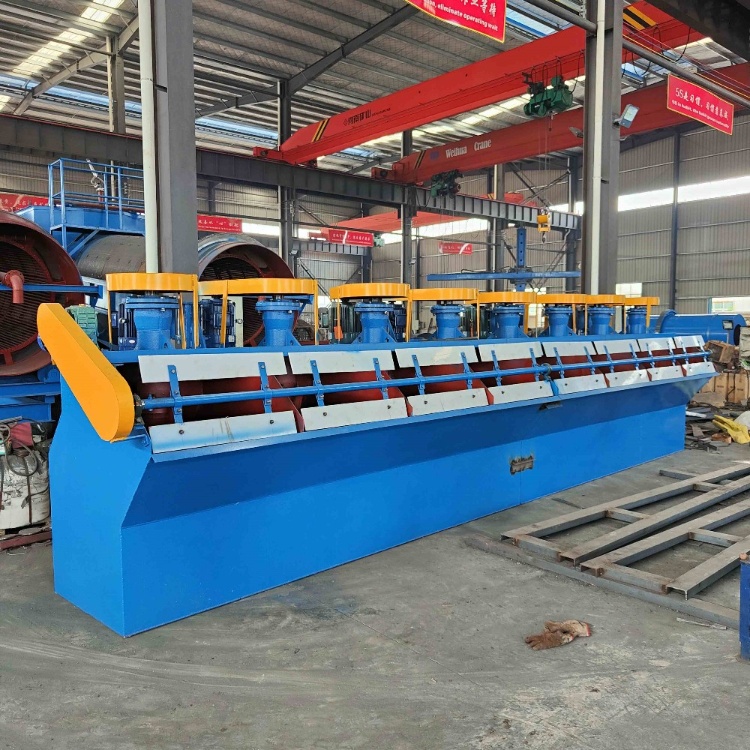
I. Causes of Flotation Machine Impeller Wear
1. Erosion Wear
Solid particles mixed in the slurry impact the flowing surface, causing sequential elastic and plastic deformation. Repeated impacts from these solid particles lead to fatigue failure, resulting in material detachment. Mild wear manifests as concentrated scratches and pitting along the flow direction; severe wear presents as wavy or grooved marks, and in extreme cases, perforation and fragmentation can occur.
2. Combined Effect of Cavitation and Erosion Wear
The impeller's rotation and discharge of the slurry create pressure, generating bubbles. Bubble formation occurs primarily through three pathways: the impeller's rotation creates negative pressure, drawing in air and forming bubbles; air dissolved in the slurry within the negative pressure zone precipitates, forming bubbles. Once formed, the bubbles move with the slurry. Bubbles contacting the impeller's inner wall collapse due to increased pressure, forming micro-jet streams towards the wall. These micro-jet streams complete a directional impact on the material surface in a very short time, generating a force equivalent to a "water hammer" effect. Metal surfaces gradually fatigue and peel off due to impact, resulting in material loss. Solid particles in the slurry, driven by cavitation, impact the metal surface; this damage is a combined effect of micro-jet impact and solid particle impact, a combination of cavitation wear and impact wear.
II. Improvement of Flotation Machine Impeller Wear
1. Changing the Blade Outlet Angle
Considering wear, a larger blade inlet edge thickness is generally used. For highly abrasive media like flotation feed, a smaller blade outlet angle can minimize particle collisions with the blade working surface. A blade outlet angle is generally selected between 30° and 40°.
2. Adjusting the Blade Outlet Width
To reduce wear, increasing the blade outlet width reduces the relative velocity at the impeller outlet, decreasing impeller wear, and also reduces the jet-wake effect at the impeller outlet, resulting in a more uniform slurry velocity distribution at the outlet.
3. Reducing the Number of Blades
The number of blades in a flotation machine is generally 4 to 7. Fewer blades reduce congestion at the impeller inlet, thereby reducing pump wear.
4. Controlling Solid Particle Size and Hardness
The particle size and hardness of solid particles in the slurry are important factors affecting the wear behavior of the impeller material. Increased particle size and hardness lead to a continuous increase in erosion particle size. Therefore, during the daily operation of the flotation machine, the particle size of the flotation feed should be strictly controlled to avoid "coarse feed," thereby reducing impeller wear.
The above explains the causes of flotation machine impeller wear and measures to reduce it. Besides changing the parameters of the flotation machine impeller and the feed particle size, the high quality of the impeller itself is also a crucial factor in increasing its lifespan. It is recommended to purchase flotation machines from manufacturers with comprehensive concentrator plant qualifications. This ensures the quality of the flotation machine while selecting equipment more suitable for the scale of the concentrator plant, thereby reducing concentrator costs and increasing return on investment.