Tel:+86 133 6177 9811
Fax:+86 0797 5712751
Email:sale02@miningshakingtable.com
Address:Guzhang Industrial Park,Shicheng County,Ganzhou City,Jiangxi Province,342700,China.
Jig separator are common gravity separation equipment that separates materials according to density differences in a vertically moving, variable-speed medium. What factors can affect jigging separation? This article will analyze this question.
Many factors can affect jigging separation indicators, mainly including material properties, mechanical structure, and operational factors. Among these, stroke, stroke frequency, undersize water addition, artificial bed composition, and feed rate are adjustable during production. While the particle size and density composition of the feed, as well as other factors, also affect jigging separation, they are not easily adjusted during production and therefore will not be analyzed in this article.
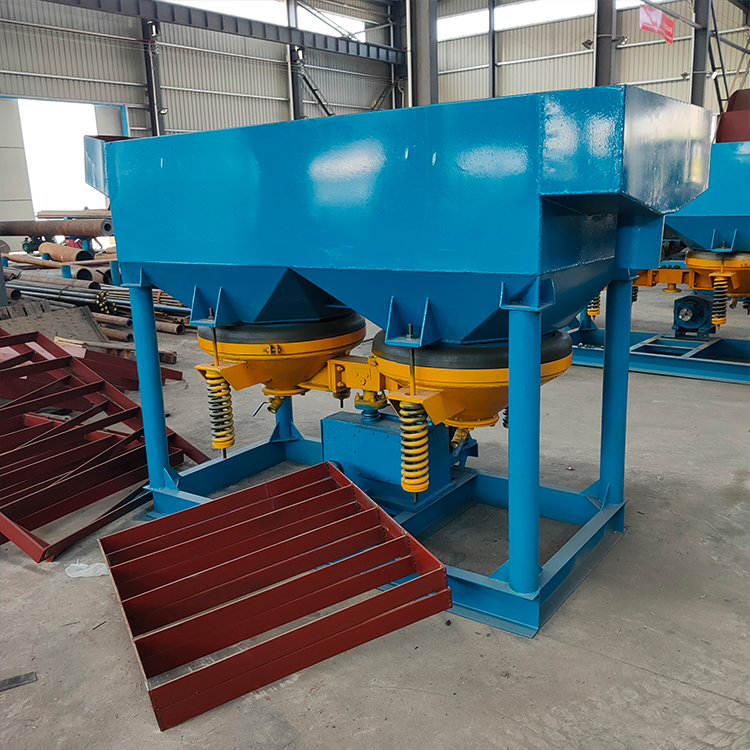
I. The Influence of Stroke and Stroke Frequency on Jig Separation
Stroke and stroke frequency are important parameters in the jigging separation process, directly related to the looseness and loosening mode of the bed, and have a significant impact on stratification. With a larger stroke, the bed lifting effect is greater, resulting in a larger loosening space; with a larger stroke frequency, the bed can maintain loosening time for a shorter period, but the stratification speed is also faster. Therefore, appropriate stroke and stroke frequency work together to achieve suitable loosening and stratification.
The required stroke and stroke frequency vary depending on the material properties, operating conditions, and different product requirements, and need to be determined through experimentation. This work is mainly carried out during commissioning. In actual production, jig operators need to constantly check the bed looseness and adjust it by changing the underflow rate. Commonly used mixing systems in production include large stroke with small stroke frequency and small stroke with large stroke frequency.
For materials with high density and coarse particle size, or in situations with large bed thickness, large throughput, and high concentrate yield, a larger stroke and smaller stroke frequency can be used. Conversely, a small stroke and large stroke frequency are suitable for separating fine-grained materials. Additionally, when the underflow rate is small, a larger stroke should also be used.
II. The Impact of Under-screen Water Addition and Feed Water on Jig Separation
Depending on the ore properties and equipment, the total water consumption in jigging varies between 3 and 8 m³/t of ore. Feed water is used to pre-wet the ore for uniform feeding. Under-screen water addition replenishes the water consumed with the tailings. It also controls the quantity and quality of under-screen concentrate by adjusting bed looseness and reducing the suction effect of excessively strong downflow. Under-screen water addition is the main method for adjusting bed looseness in production and must be controlled continuously based on bed looseness, concentrate yield, and quality requirements.
III. The Impact of Bed Thickness and Artificial Bed Stone on Jig Separation
Bed thickness primarily affects the degree of ore looseness and the stratification rate within the jig. For ores with significant density differences between valuable minerals and gangue minerals, a two-layer bed distribution can be used to accelerate ore stratification and increase production capacity; the higher the concentrate quality requirements, the thicker the bed. Bed thickness can be calculated using the height between the screen surface and the tailings plate. When using a diaphragm mill to process medium to fine-grained ores, the total bed thickness should not be less than 5 to 10 times the largest particle size of the feed, generally between 120 and 300 mm. For coarse-grained ores, the bed thickness should be at least 500 mm. When separating fine-grained ores (-2 mm), the concentrate can be processed using a through-screen discharge method. In this case, an artificial bed must be laid on the screen plate to control the quantity and quality of the concentrate, and the bed stones used must be able to consistently remain at the bottom of the bed. In production, heavy mineral aggregates, cast iron balls, magnetite, or high-density pebbles are often used. The particle size of the bed stones should be at least 3 to 6 times the largest particle size of the feed ore and 1.5 to 2 times larger than the screen openings. Furthermore, the thickness of the artificial bed directly affects the quantity and quality of the undersize concentrate. When processing fine-grained tungsten and tin minerals, the artificial bed thickness is 10-50 mm; when processing iron ore, the artificial bed thickness is 4-6 times the maximum feed particle size of the iron ore. When the bed material has coarse particle size, low density, and a thin artificial bed, the artificial bed has large pores, allowing fine-grained minerals to easily pass through, thus increasing the concentrate recovery rate, but the concentrate grade is lower. Conversely, under the opposite conditions, the recovery rate is lower, but the concentrate grade is higher.
IV. The Influence of Feed Properties and Feed Rate on Jig Separation
Generally, the feed particle size of a jig should not exceed 25%-30%. For jigs of different specifications and models, factors such as feed particle size, mineral density, and operational requirements can all affect the jig's processing capacity, requiring analysis based on specific circumstances.