Tel:+86 133 6177 9811
Fax:+86 0797 5712751
Email:sale02@miningshakingtable.com
Address:Guzhang Industrial Park,Shicheng County,Ganzhou City,Jiangxi Province,342700,China.
Recently, a friend left a message saying that his ball mill frequently discharges unground crushed stones from the outlet, and the quantity is quite large. This not only increases the power consumption for grinding materials but also increases the labor intensity for personnel. So, what are the reasons for this phenomenon?
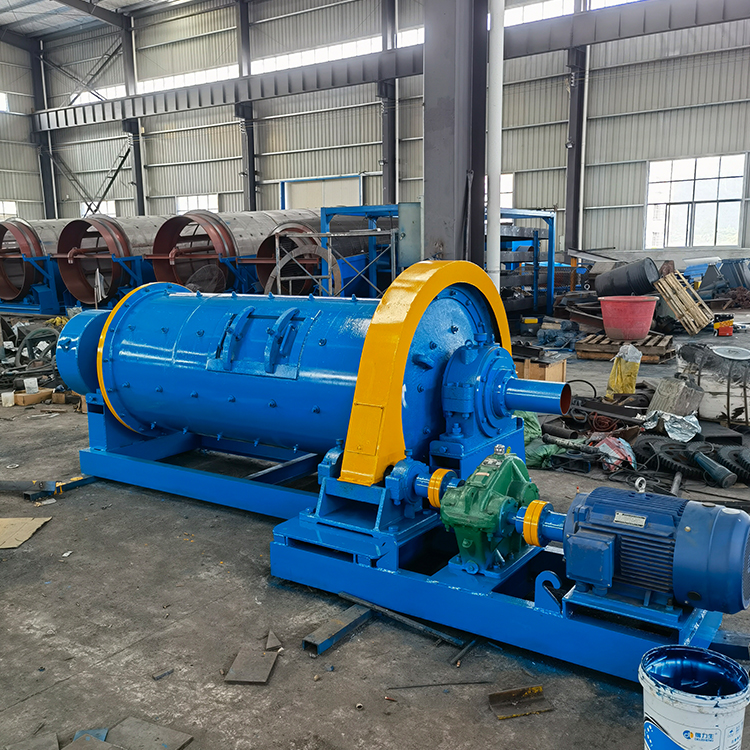
They are mainly the following:
1. The particle size of the incoming material is too large, causing the ball mill to be unable to process it adequately and resulting in the discharge of stones.
Excessively large particles will put an extra burden on the ball mill, and some oversized particles are not easily crushed by the steel balls, leading to a decrease in the ball mill's processing capacity and increased power consumption. With continuous feeding of new material, the uncrushed stones will be discharged from the mill through the outlet.
Therefore, during operation, the particle size of the material on the feeder should be closely monitored. If the particle size exceeds the designed maximum particle size, the feeding should be immediately reduced or stopped, and corresponding measures should be taken to ensure that the particle size of the feed is within the acceptable range.
2. Insufficient replenishment of steel balls
Due to the long-term operation of the mill, the steel balls wear out severely, their diameter decreases, and the impact force weakens accordingly. When the steel balls in the ball mill are not replenished in time, the ball mill's processing capacity will be insufficient.
Therefore, to maintain a certain ball filling coefficient and steel ball diameter, qualified steel balls should be added to the ball mill regularly according to the ball mill's current and the amount of material ground.
3. Is the size ratio of the added steel balls reasonable?
Generally, manufacturers recommend that the steel balls added each time should be of the designed maximum size. However, even when the ball mill is not short of steel balls, the processing capacity of the ball mill is still difficult to reach the level of its initial operation. Therefore, further exploration is needed regarding the size ratio of the added balls.
4. Damage to the lining of the mill cylinder
A well-maintained lining in the ball mill increases the friction coefficient between the steel balls and the lining, thus improving the mill's processing capacity. With a severely worn lining, there is greater relative sliding between the steel balls and the lining, resulting in more energy being consumed by friction between the steel balls and the lining, which is not used to lift the steel balls. The ball mill's processing capacity will significantly decrease. When the lining plates inside the ball mill are damaged or fall off, a distinct banging sound can be heard. In such cases, the ball mill should be stopped immediately to address the damaged lining plates and prevent extensive damage.