Tel:+86 133 6177 9811
Fax:+86 0797 5712751
Email:sale02@miningshakingtable.com
Address:Guzhang Industrial Park,Shicheng County,Ganzhou City,Jiangxi Province,342700,China.
Gold exists as a single, naturally occurring substance, with a density significantly different from gangue, generally exceeding 16 tons per cubic meter. Gold mining equipment utilizes methods such as flotation, carbon-in-pulp (CIP), and gravity separation. Gravity separation and flotation are commonly used methods in gold mining, with significant improvements in both technology and equipment. The mainstream gold mining process typically involves crushing the minerals using a crusher, followed by grinding in a ball mill. Then, gravity and flotation processes are used to extract concentrates and tailings. Finally, chemical methods are employed, and the final product is smelted to obtain finished gold.
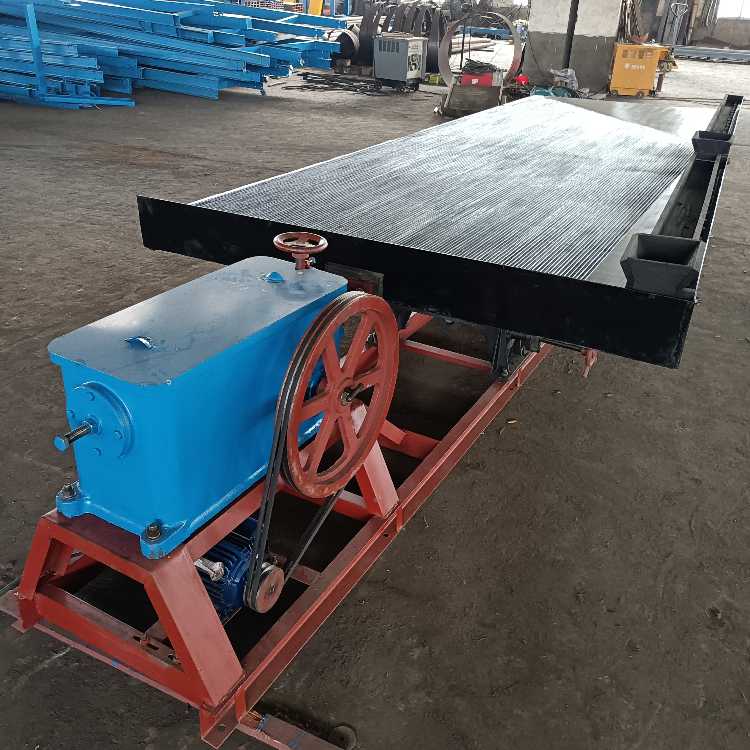
Main equipment for gravity separation in gold mining includes sluices, jigs, and shaking tables. Other gravity separation equipment includes pulverized sluices, circular jigs, and placer centrifuges.
The principle of flotation in gold mining: Mineral particles possess hydrophobic properties on their surface, or these properties are enhanced or increased by flotation reagents. Hydrophobicity means being both oleophilic and gas-philic, allowing them to aggregate at liquid, gas, or water-oil interfaces. Although gold ore particles, after a series of processing steps, have a high density, they can still bind with air bubbles and flotation agents, floating on the surface of the flotation solution and being recovered as a froth product.
Gold ore beneficiation equipment is suitable for separating gold ore particles from 0.5mm to 10µm. When the feed particles are smaller than 10µm, special flotation methods are required. Commonly used flocculants cause fine gold or gold-bearing minerals to flocculate into larger particles, removing gangue and fine mud, and then the coarse gangue particles are floated away; this is flocculation-flotation. Carrier flotation uses mineral particles of suitable size as a carrier, causing fine gold particles to adhere to the carrier surface and float to the surface, forming a gold concentrate. Oil agglomeration flotation and emulsion flotation use oils to agglomerate fine mineral particles for flotation. Separation flotation, which utilizes high-temperature chemical reactions to convert metallic minerals in the ore into metals before flotation, is not commonly used for gold ores. Regarding the use of froth flotation for gold mud recovery, my country plans to apply it in the industrial sector.
Applicable scope of gravity separation for gold ore beneficiation equipment:
1. Primarily used in placer gold deposits: Gold exists as individual, naturally occurring gold particles with a significant density difference from gangue, generally greater than 16 tons/cubic meter.
2. Rarely used alone in vein gold deposits: It can be used in small-scale gold mines and local cluster mines. For convenience in subsequent flotation and hydrogenation operations, jigs and spiral sluices are used in conjunction with shaking tables to recover the liberated coarse-grained individual gold particles in advance during the grinding and classification circuits, thereby obtaining qualified gold concentrate.