Tel:+86 133 6177 9811
Fax:+86 0797 5712751
Email:sale02@miningshakingtable.com
Address:Guzhang Industrial Park,Shicheng County,Ganzhou City,Jiangxi Province,342700,China.
The beneficiation method for antimony ore should be selected based on the ore type, mineral composition, mineral structure, and intercalation characteristics, among other physical and chemical properties. It should also consider the content of valuable components, suitability for antimony metallurgical technology, and ultimate economic benefits. Beneficiation methods for antimony ore include hand sorting, gravity separation, flotation, and heavy media separation. A gravity centrifuge is recommended for antimony ore beneficiation.
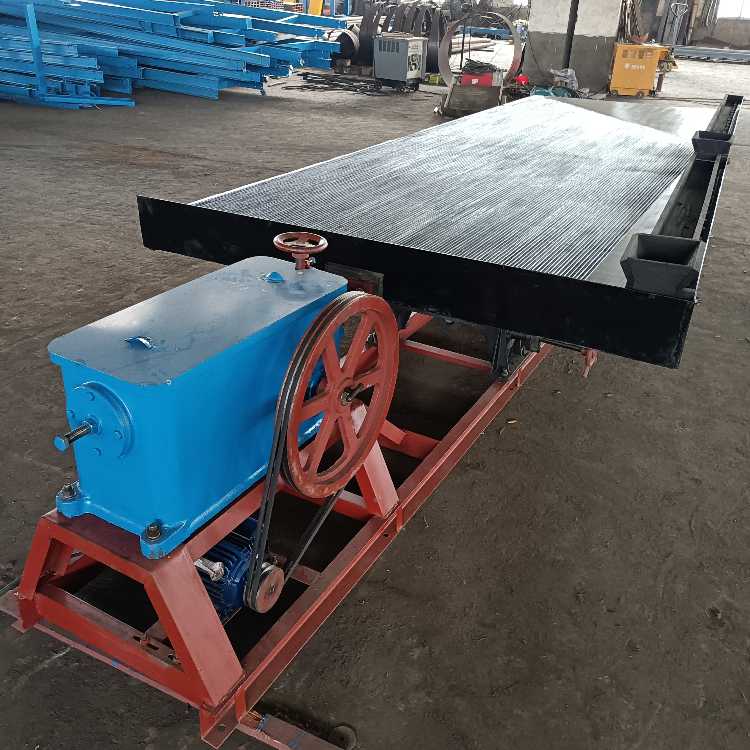
Gravity separation is suitable for most antimony ore plants because antimony minerals are dense and coarse-grained, making them easy to separate from gangue using gravity separation. Specifically, stibnite has a density of 4.62 g/cm³, while gangue density ranges from 2.6 to 2.65 g/cm³. Their equal settling ratio makes them easily beneficiated ores; therefore, antimony ore is an extremely easy ore to beneficiate based on density. Both single antimony sulfide ores and mixed antimony sulfide-oxide ores have good gravity separation conditions. Gravity separation equipment is inexpensive and can separate a large amount of qualified coarse-grained concentrate within a relatively coarse-grained range while discarding a large amount of gangue. Therefore, gravity separation remains a preferred beneficiation method for antimony ore processing. Sometimes, even if it cannot directly produce qualified antimony concentrate, it is often accepted as a pre-selection step in antimony flotation. Especially given the current difficulties in processing antimony oxide ores through flotation, gravity separation has become the primary beneficiation method for antimony oxide ores.
Antimony minerals can be classified into three types according to their natural composition: oxidized ore, mixed ore, and primary ore. The standard classification is based on the antimony oxidation rate (%): oxidized ore 50%, mixed ore 30%-50%, and primary ore 30%. my country's antimony deposits include single-component deposits dominated by antimony, but more often they are multi-component associated deposits, such as antimony associated with gold, mercury, and tungsten. Based on this, my country's antimony ore industry types include single antimony, antimony-gold, antimony-mercury, antimony-gold-tungsten, and antimony-tungsten types. Antimony-containing polymetallic minerals are often accompanied by various heavy non-ferrous metal sulfides, and sometimes by economically valuable oxide minerals such as cassiterite and scheelite, as well as precious metal minerals such as native gold. Therefore, comprehensive recovery needs to be considered during mineral processing.