Tel:+86 133 6177 9811
Fax:+86 0797 5712751
Email:sale02@miningshakingtable.com
Address:Guzhang Industrial Park,Shicheng County,Ganzhou City,Jiangxi Province,342700,China.
I. Introduction to Mineral Processing Shaking Tables
A mineral processing shaking table is a gravity separation device primarily used for separating fine-grained ores (particle size range 2-0.022 mm). It is widely used in the separation of rare and precious metals such as tungsten, tin, tantalum, niobium, gold, and silver, and can also be used for the recovery of ferrous metals such as iron and manganese, and non-metallic minerals (such as silica sand). Its core structure consists of three main parts: the bed surface, the frame, and the transmission mechanism, along with auxiliary components such as a flushing trough and a feed trough. The bed surface often adopts a hyperboloid wave design (advanced domestic flow film shaking table), achieving longitudinal reciprocating asymmetrical motion through a crank-connecting rod transmission, combining the force of water flow and inertia to complete the stratification and separation of mineral particles.
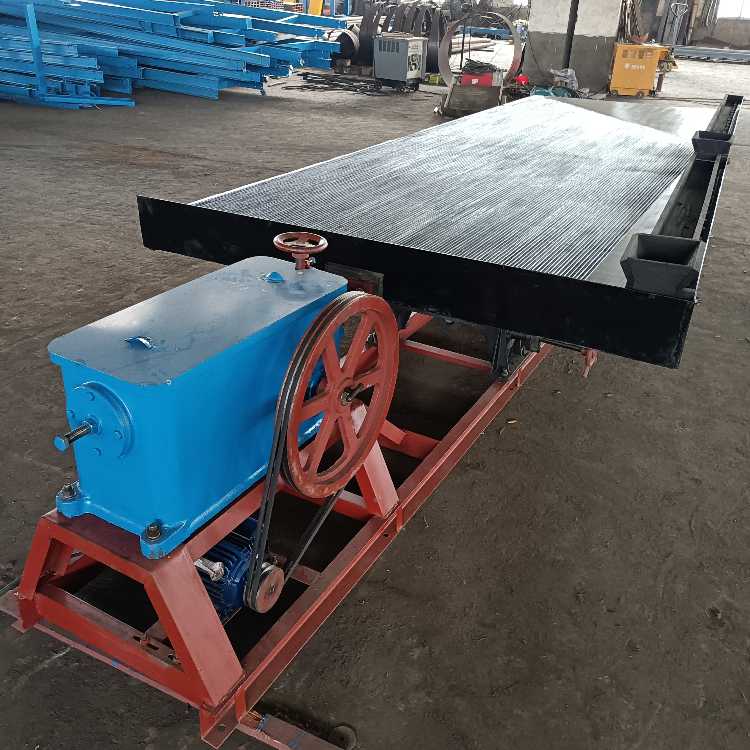
II. Working Principle of a Mineral Processing Shaking Table
The separation process of a mineral processing shaking table is based on the difference in mineral particle density, achieving separation through two steps: loose stratification and transport-separation:
1. Loose Stratification: After the slurry enters the table, the transverse water flow across the bed bars agitates eddies. The upper layer of fine particles remains suspended, while slightly coarser particles, during tumbling, transfer heavier minerals to the lower layer. The lower layer of mineral particles is affected by the longitudinal shaking of the table surface. Due to the difference in shear velocity, the particles between layers are compressed, further widening the gaps. Heavy minerals, due to the localized high pressure, displace lighter minerals into the lower layer, ultimately achieving separation and stratification (fine heavy minerals at the bottom, coarse heavy minerals next, and light minerals at the top).
2. Transport-Separation: After stratification, the mineral particles are subjected to the combined effects of transverse water flow washing and longitudinal differential shaking of the table surface. Mineral particles of different densities move in different directions: fine heavy minerals move fastest longitudinally (towards the concentrate end) and have the lowest transverse velocity; coarse light minerals move in the opposite direction, with a high transverse velocity and a low longitudinal velocity. Ultimately, the mineral particles fan out diagonally along the bed surface, exiting from the concentrate end, middlings end, and tailings end respectively, achieving the separation of concentrate, middlings, and tailings.
III. Advantages of Mineral Processing Shaking Tables
The mineral processing shaking table is a key piece of equipment for fine-grained ore separation due to its unique advantages:
High separation accuracy: It can accurately separate mineral particles of different densities, achieving a rich-ore ratio (the ratio of concentrate grade to raw ore grade) of over 100 times. Qualified concentrate can be obtained in a single separation, reducing subsequent processes.
Wide adaptability: It can handle different particle sizes of ores, including coarse sand (2-0.5 mm), fine sand (0.5-0.074 mm), and slime (-0.074 mm). It is suitable for multiple processes such as roughing, cleaning, and scavenging, and can even be used for the recovery of metals from waste electronic equipment.
Simple operation: The bed surface clearly shows the separation zones, and the operating status can be observed visually. Adjusting parameters (such as slope and stroke) is convenient, making it easy for beginners to operate. • Environmentally friendly and energy-saving: No chemical reagents are required; it consumes only a small amount of electricity (1.1 kW per motor), and wastewater can be recycled. Operating costs are low and there is no environmental pollution.
High durability: The mainstream fiberglass bed surface adopts a "polyester fiberglass + steel frame" structure with a special wear-resistant layer. It is corrosion-resistant, wear-resistant, and not easily deformed, offering better cost-effectiveness than traditional wooden beds (easily damaged) and aluminum alloy beds (high cost).
In summary, the mineral processing shaking table, with its advantages of high precision, wide adaptability, and ease of operation, occupies an important position in the field of fine-grained ore separation and is one of the key pieces of equipment for mining enterprises to enhance the value of mineral resources.