Tel:+86 133 6177 9811
Fax:+86 0797 5712751
Email:sale02@miningshakingtable.com
Address:Guzhang Industrial Park,Shicheng County,Ganzhou City,Jiangxi Province,342700,China.
Placer gold, an important gold resource, is primarily beneficiated based on the density difference between gold and gangue minerals. Since placer gold exists mostly in a free state within the ore and its specific gravity is much higher than ordinary sand and gravel (gold's specific gravity is approximately 19.3, while gangue minerals such as quartz are only around 2.65), gravity separation has become the most economical and efficient mainstream technology.
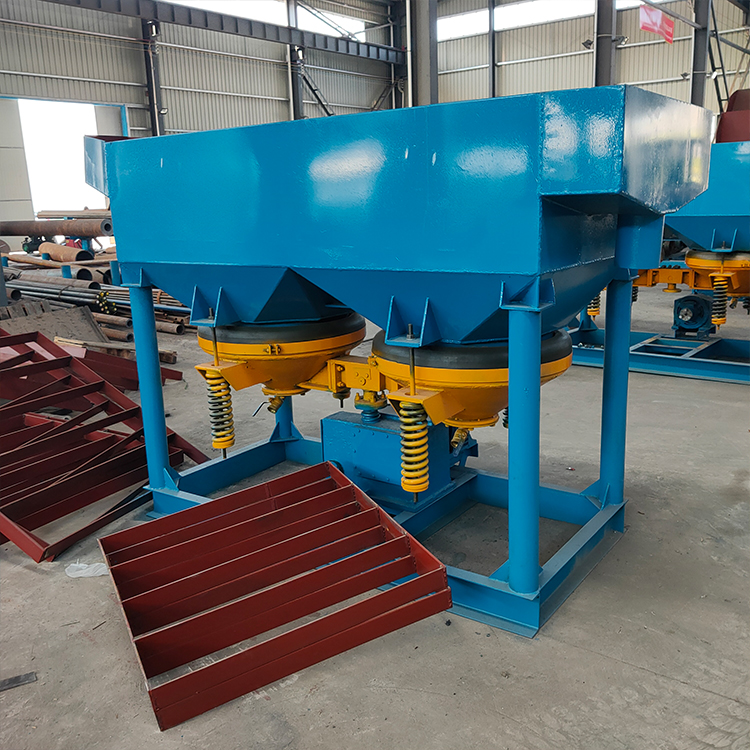
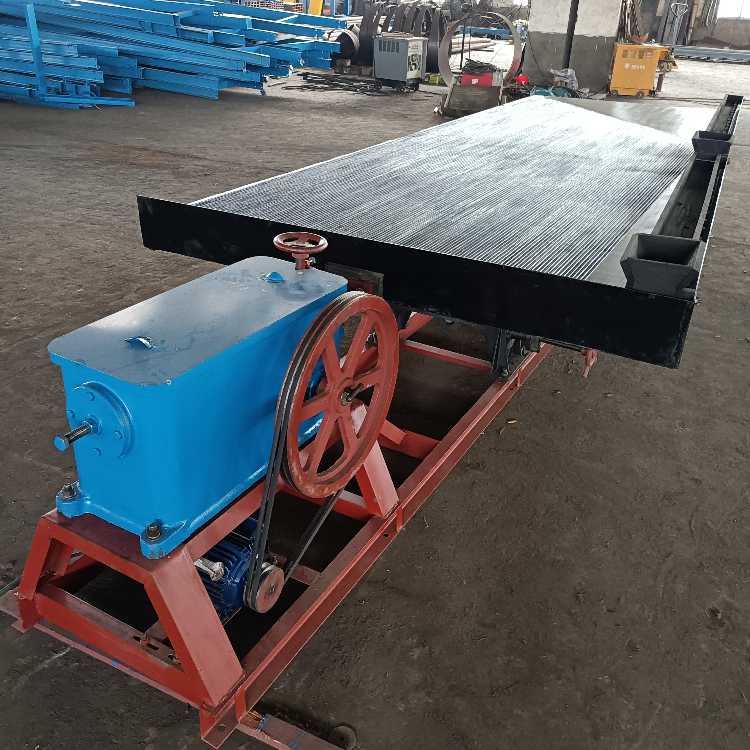
Gravity separation mainly includes jigging, sluice box beneficiation, and shaking table beneficiation processes. Jigging machines utilize vertical alternating water flow to stratify the ore sand according to density, quickly recovering coarse gold particles of 0.5–5 mm. It has a large throughput and high efficiency, and is often used in the roughing stage. Sluice boxes rely on the shearing action generated by water flowing on an inclined plane, causing heavy minerals to settle to the bottom of the trough, suitable for enriching medium and fine-grained gold. Shaking tables, as a cleaning device, use the asymmetric reciprocating motion of the table surface in conjunction with transverse water flow to further purify the gold concentrate, obtaining a higher-grade final concentrate.
For placer gold deposits with high mud content, washing and screening are essential pretreatment steps. Rotary drum screens or vibrating screens are commonly used to remove large gravels and clay, preventing equipment blockage and improving subsequent sorting efficiency. For fine-grained gold (<0.074mm), conventional gravity separation yields low recovery rates; therefore, enhanced gravity separation equipment such as centrifugal concentrators can be used to utilize high centrifugal force to improve the collection capacity of fine gold.
In specific cases, a combination of amalgamation, flotation, or magnetic separation can be used for comprehensive recovery. For example, amalgamation is effective in collecting free gold; flotation is suitable for fine-grained gold associated with sulfides; and magnetic separation can be used to remove iron mineral impurities, improving the quality of gold concentrate. The actual beneficiation process should be flexibly combined according to the ore characteristics to achieve efficient resource utilization and maximum recovery.