Tel:+86 133 6177 9811
Fax:+86 0797 5712751
Email:sale02@miningshakingtable.com
Address:Guzhang Industrial Park,Shicheng County,Ganzhou City,Jiangxi Province,342700,China.
Wolframite is characterized by its high density, brittleness, and tendency to become muddy. Its beneficiation process generally employs a combined flow method, primarily gravity separation supplemented by various cleaning methods. The aim is to efficiently recover valuable minerals while comprehensively recovering associated valuable components. The complete beneficiation process typically consists of four stages: pre-enrichment, classification and gravity separation, cleaning and purification, and fine slime treatment.
Pre-enrichment is the preparatory work before beneficiation. Due to the uneven distribution of wolframite within quartz veins and its high mining dilution rate, the ore is first prepared to a suitable particle size (e.g., ≤20mm) through washing, crushing, and screening. Subsequently, methods such as heavy media separation, photoelectric separation, or manual sorting are used to discard a large amount of coarse waste rock, directly improving the ore's feed grade.
Classification and gravity separation is the core step in recovering wolframite. To protect the ore from over-grinding due to its low hardness, rod mills are typically used to ensure uniform product particle size. The beneficiation process follows the principle of "stage grinding and stage separation." Coarse-grained wolframite is recovered in jigs, while fine-grained wolframite is fed to shaking tables or spiral sluices for further separation. This stage yields a lower-yield but higher-grade rough concentrate; the recovery rate of gravity separation is typically over 90%.
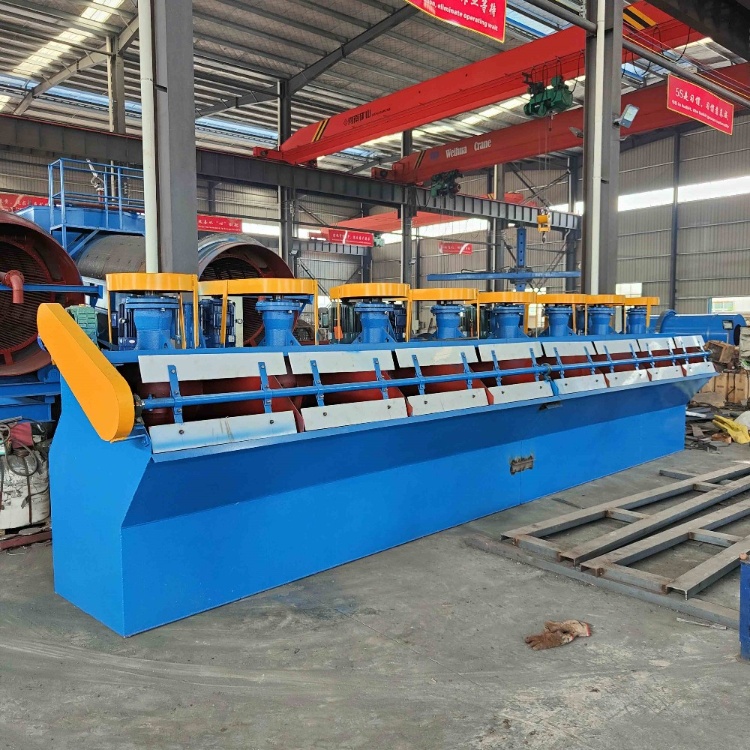
The subsequent refining and purification process aims to improve concentrate quality and comprehensively recover associated elements. The rough concentrate obtained from gravity separation needs to be refined to separate wolframite from cassiterite, scheelite, and various sulfide minerals (such as chalcopyrite and pyrrhotite). The refining process typically employs a combination of flotation desulfurization, strong magnetic separation to separate wolframite from weakly magnetic minerals, and electrostatic separation to separate cassiterite, ultimately obtaining qualified tungsten concentrate and various byproducts such as copper, bismuth, and tin.
Fine slime treatment is crucial for improving recovery rates. For the fine wolframite slime (usually referring to -37μm particle size) generated during the gravity separation process, due to the difficulty in its recovery, it is often treated separately using processes such as centrifuge pre-enrichment, flotation or high gradient magnetic separation to fully recover the fine-grained tungsten minerals.