Tel:+86 133 6177 9811
Fax:+86 0797 5712751
Email:sale02@miningshakingtable.com
Address:Guzhang Industrial Park,Shicheng County,Ganzhou City,Jiangxi Province,342700,China.
Scheelite, a major source of the strategic metal tungsten, has its beneficiation processes primarily determined by the ore's grain size and the type of associated gangue. Currently, the industry widely employs a combined process flow with flotation as the main method, supplemented by gravity separation and magnetic separation.
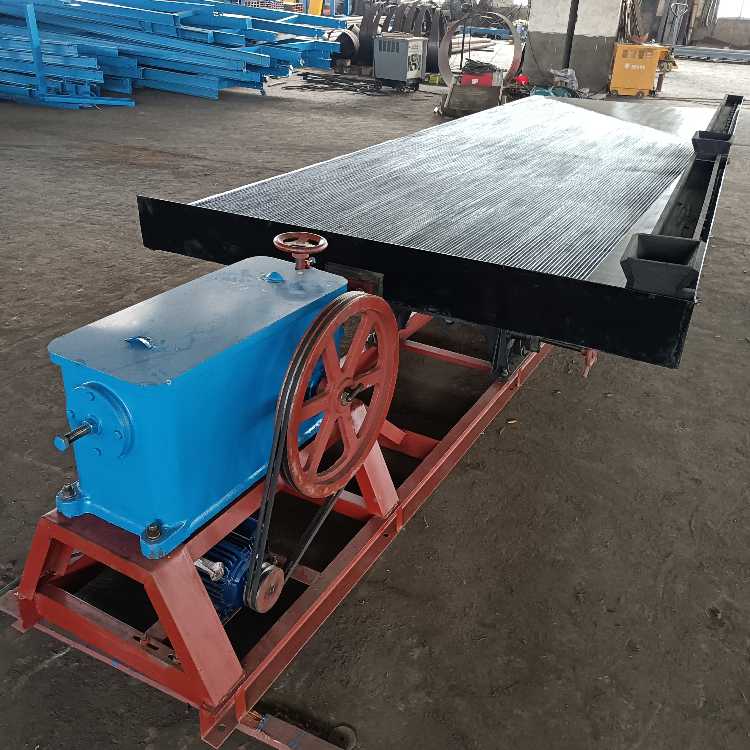
Gravity separation is mainly used to recover coarse-grained scheelite. Utilizing the density difference between scheelite and gangue minerals, jigs are commonly used to process coarse particles (+2mm), spiral sluices to process medium-fine particles (2-0.074mm), and shaking tables are used to produce the final concentrate. For the pre-enrichment stage, high-intensity magnetic separation is also often used to remove magnetic gangue such as garnet to prevent over-grinding and mud formation, thereby improving the feed grade.
Flotation is the mainstream method for processing fine and micro-fine-grained scheelite and is the core technology for dealing with "poor, fine, and impurity" resources. Because scheelite often has similar floatability to calcium-bearing gangue such as calcite and fluorite, separation is difficult. The typical process involves preferential sulfur flotation, where sulfide ores are first floated in an alkaline medium (pH 9-10.5) using xanthate collectors, followed by scheelite flotation in the tank. Sodium carbonate is commonly used to adjust the pH during the scheelite flotation stage, water glass is used to suppress quartz and silicates, and fatty acids (such as oleic acid and oxidized paraffin soap) are used as collectors.
The refining of the rough concentrate is crucial for obtaining high-grade tungsten concentrate. To address the difficulty in separating calcium-bearing gangue, the well-known "Petrov process" (heated refining) is commonly used industrially. This method concentrates the rough concentrate into a thick slurry, adds a large amount of water glass, and heats it to above 80°C with vigorous stirring. Utilizing the difference in the rate of collector film desorption on the mineral surfaces, calcite and fluorite are selectively suppressed, thereby achieving re-enrichment of scheelite. In recent years, research on ambient temperature flotation processes and novel reagent combinations has also made continuous progress to adapt to increasingly complex ore properties.