Tel:+86 133 6177 9811
Fax:+86 0797 5712751
Email:sale02@miningshakingtable.com
Address:Guzhang Industrial Park,Shicheng County,Ganzhou City,Jiangxi Province,342700,China.
Detailed Explanation of the Structure of a Mineral Processing Shaking Table: The Core of Gravity Separation
The mineral processing shaking table is a long-established gravity separation device with extremely high separation accuracy. It is mainly used to process rare and precious metal ores such as tungsten, tin, and gold, effectively separating particles ranging from 3 to 0.019 mm. While its structure appears simple, the precise coordination of its various parts achieves highly efficient separation of minerals with different densities. A complete mineral processing shaking table mainly consists of three core parts: the table surface, the frame, and the transmission mechanism.
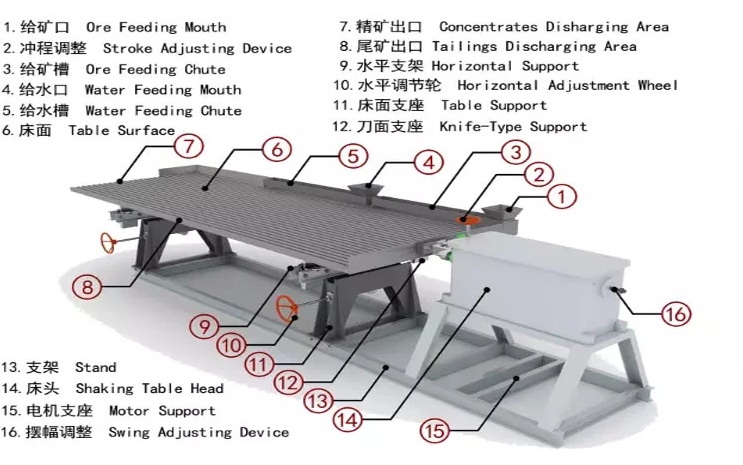
Table Surface: The Direct Carrier for Separation
The table surface is the core working component of the shaking table, typically trapezoidal, rhomboid, or right-angled trapezoidal in shape. To accommodate materials of different particle sizes, the table surface material varies, commonly including grooved (painted ash) wooden table surfaces, rubber table surfaces, and lightweight and durable fiberglass table surfaces. The table surface has a transverse inclination of 1°to 5° and is arranged longitudinally with densely packed ribs (or bed strips). The height of these grooves gradually decreases from the transmission end to the opposite side, serving as important channels for particle stratification and movement. A feed trough and a water trough are located at one corner above the bed surface for uniformly feeding slurry and flushing water.
Gear Box: The Heart of Power
The gear box, also known as the headstock, is the key component driving the reciprocating motion of the shaking table. The electric motor drives a crank-connecting rod mechanism or cam-lever mechanism via belt drive, converting rotational motion into asymmetrical longitudinal reciprocating motion of the bed surface. This motion has a quick-return characteristic: the speed increases rapidly when the bed advances and decreases rapidly when it retreats. It is this differential motion that allows the mineral particles on the bed surface to receive a selective forward transport force.
Frame and Inclination Adjustment Device: Stable Support
The entire bed surface is supported or suspended by a frame, which is equipped with an incline adjustment device for precisely adjusting the lateral incline of the bed surface (typically 0°to 10°). In addition, a buffer spring is often installed between the base and the bed surface to absorb vibration energy and ensure smooth operation of the equipment.
Besides the main components mentioned above, the shaking table also includes auxiliary devices such as a lubrication system and a flushing water trough, which together ensure the efficiency and stability of the mineral processing process.