Tel:+86 133 6177 9811
Fax:+86 0797 5712751
Email:sale02@miningshakingtable.com
Address:Guzhang Industrial Park,Shicheng County,Ganzhou City,Jiangxi Province,342700,China.
In the field of mineral processing, the flotation machine is the core equipment for mineral separation, widely used in the separation of non-ferrous metals, ferrous metals, non-metallic minerals, and coal. Its basic principle is based on the differences in the physicochemical properties of mineral surfaces. By adding reagents and aerating/stirring, the target mineral selectively adheres to air bubbles, floats to the surface of the slurry, forming a froth layer, and thus separates from gangue minerals.
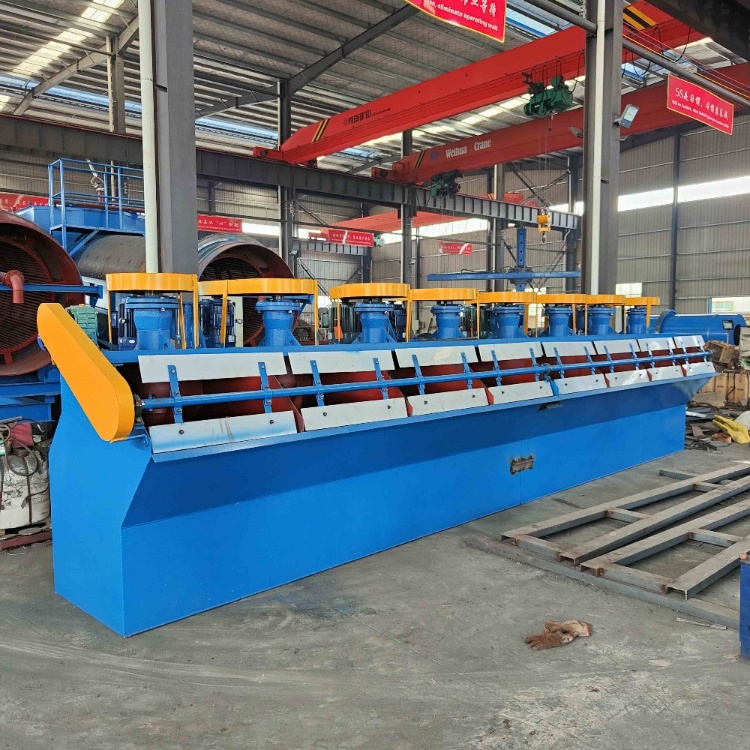
Structure and Classification
A flotation machine mainly consists of a tank, an aeration device, a stirring mechanism, a froth scraper, and a circulation system. Based on the different aeration and stirring methods, industrially used flotation machines can be divided into two main categories:
Mechanically stirred flotation machines (such as the XCF and KYF types) rely on impellers and stators to achieve aeration and circulation of the slurry. They have the ability to self-absorb air and slurry, and offer flexible process configurations, making them the mainstream choice for small and medium-sized mineral processing plants. Among them, the KYF type is an aerated type, requiring an external blower for air supply, and has relatively low energy consumption; while the XCF type also has self-aspiration capability and is often used in conjunction with the KYF type to achieve middlings return from the slurry.
Aerated flotation machines (such as flotation columns) adopt a non-mechanically agitated structure, generating microbubbles through a bubble generator, with the slurry and bubbles coming into countercurrent contact within the column. Its characteristics include simple structure, small footprint, and ease of large-scale development, making it particularly suitable for the separation of fine-grained minerals, but requiring high levels of automation control.
Development Trends
With the large-scale development and utilization of lean, fine, and difficult-to-process ores, flotation machines are developing towards larger scale, higher intelligence, and greater energy efficiency. Single-cell volume has increased from a few cubic meters in the early days to over 600 cubic meters currently, with larger scale significantly reducing equipment investment and operating costs per unit capacity. At the same time, intelligent control systems based on foam image analysis and online slurry monitoring are gradually being applied, enabling precise adjustment of liquid level, aeration rate, and reagents, effectively improving separation indicators and production stability.
Conclusion
As a key piece of equipment in the mineral processing flow, the performance of flotation machines directly affects concentrate grade and recovery rate. Correct selection, reasonable configuration, and meticulous operation are crucial guarantees for maximizing flotation efficiency and achieving efficient resource utilization. With continuous innovation in mineral processing technology and equipment, flotation machines will play an even more important role in the comprehensive utilization of mineral resources.