Tel:+86 133 6177 9811
Fax:+86 0797 5712751
Email:sale02@miningshakingtable.com
Address:Guzhang Industrial Park,Shicheng County,Ganzhou City,Jiangxi Province,342700,China.
In placer gold mining, efficiently separating fine gold particles from large volumes of sand and gravel is crucial. Among various mineral processing methods, gravity separation stands out as the preferred technique for processing placer gold deposits due to its low investment cost, simple operation, absence of chemical pollution, and high recovery rate. Placer gold gravity separation equipment is the key to achieving this goal.
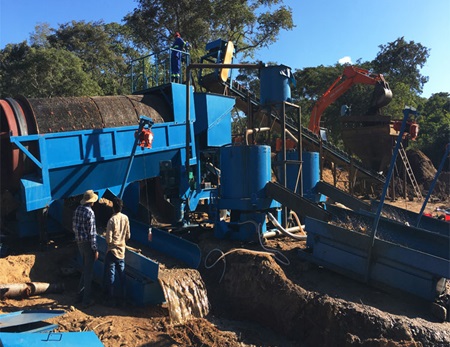
Gravity separation (referred to as "gravity concentration" or "gravimetric separation") is a method that separates minerals based on differences in density (specific gravity) within a moving medium (water or air), utilizing hydrodynamic and mechanical forces.
Gold has an extremely high specific gravity (15.6-19.3), far exceeding that of common gangue minerals like quartz (specific gravity approximately 2.65). This significant density difference makes gravity separation exceptionally efficient for isolating gold. Using placer gold gravity separation equipment, the high-density gold particles settle to the bottom of the equipment and are collected, while the lower-density sand and silt are carried away by the water flow, thus achieving separation and purification.
A complete placer gold gravity separation production line typically consists of washing, screening, and gravity separation stages. Here are several core pieces of gravity separation equipment:
Working Principle: Utilizes an alternating vertical (pulsating) water flow, causing the particle bed to alternately loosen and compact. Gold particles, leveraging their density advantage, penetrate the gaps in the bed and sink, becoming concentrate, while lighter minerals remain in the upper layer and are discharged.
Advantages: Large processing capacity, wide effective particle size range (from a few millimeters down to tens of microns), stable operation. It is the primary equipment for the roughing stage of placer gold.
Working Principle: The deck undergoes an asymmetric reciprocating motion driven mechanically, while simultaneously being subjected to a transverse flow of water. Mineral particles are separated based on density and size under the combined action of gravity, friction, hydraulic drag, and inertial forces from the deck, forming fan-shaped zones on the table surface to produce concentrate, middlings, and tailings.
Advantages: Very high separation precision, high enrichment ratio. Often used for cleaning and scavenging concentrates from jigs, capable of producing high-grade gold concentrate.
Working Principle: Generates centrifugal force tens or even hundreds of times greater than gravity through a high-speed rotating drum, significantly intensifying the separation process. It effectively recovers very fine gold particles (e.g., -0.074mm / -200 mesh), which are difficult for traditional gravity equipment to handle efficiently.
Advantages: High recovery rate for fine gold, small footprint. It is a key piece of modern placer gold processing equipment for improving overall recovery rates.
Working Principle: As the ore pulp flows down an inclined chute, heavy minerals settle and are trapped behind riffles (bars) or in carpet-like matting on the bottom, while lighter minerals are carried away by the water flow.
Advantages: Simple structure, low cost, requires no external power. An ideal choice for individual prospectors and small-scale mining operations.
Selecting the correct equipment is half the battle. Equipment selection requires comprehensive consideration of the following factors:
1. Ore Properties: Understanding the particle size distribution of the gold in the placer deposit (whether it's coarse, flaky, or very fine), the clay content, and the ore throughput are fundamental.
2. Processing Capacity: Select equipment specifications based on the planned daily tonnage to ensure matching production capabilities.
3. Process Flow: A combined flowsheet of "Roughing - Scavenging - Cleaning" is typically used. For example: using a jig for roughing and scavenging to process bulk feed material, and using a shaking table or centrifugal concentrator to clean the rough concentrate and increase the gold grade.
4. Investment Budget: Balance equipment costs, operating costs, and expected returns.